
Underground Ecosystems of the Kruger National Park
🌿 How Soil Type Shapes the World Around Plant Roots
When visitors enter the , they usually notice elephants, lions or vast savanna landscapes. But one of the most important ecosystems in the park lies completely hidden — the microbial world surrounding plant roots. This underground zone, known as the rhizosphere, is where plants and microbes interact continuously, exchanging nutrients, chemical signals and energy. It is one of the most biologically active environments on Earth.
🦠 The Secret Life Around Roots
Plant roots are not alone in the soil. They are surrounded by millions of bacteria forming what scientists call a MICROBIOME – or more accurately a rhizobiome (= rhizosphere microbiome). This is a specialised microbial community shaped by both the plant and its environment.
These microbes:
help plants obtain nutrients,
influence water uptake,
protect roots from disease,
and ultimately help determine which plants survive in an ecosystem.
Understanding this hidden partnership helps scientists explain how entire landscapes function.
🌍 A Natural Veld Laboratory
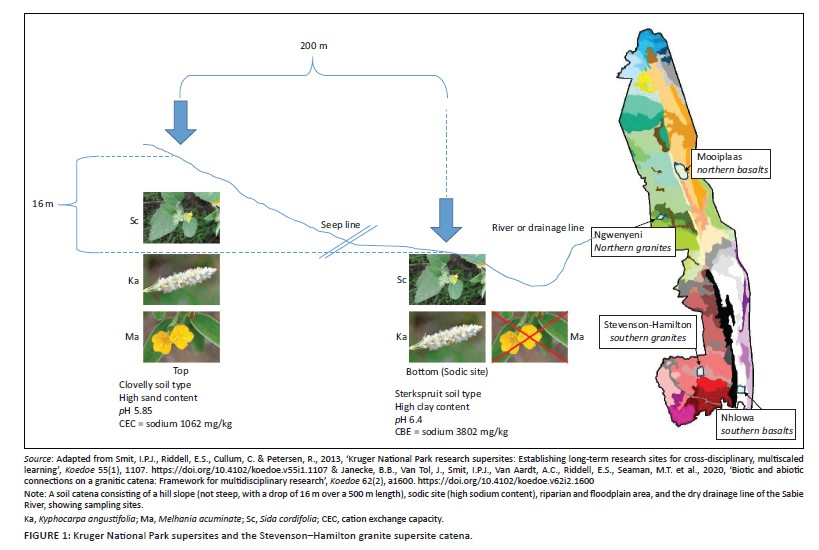
Researchers studied microbial communities at the Stevenson–Hamilton research supersite, a unique landscape where soil changes naturally along a slope known as a granite catena. Along this slope:
Clovelly soils occur higher up — sandy, acidic and relatively nutrient-poor.
Sterkspruit soils occur lower down — clay-rich, saltier and better at retaining water.
Although these soils may look similar from above, underground they create very different living conditions for microbes.
🌱 Three Plants, Two Soils, One Question
Scientists investigated the rhizosphere microbes associated with three herbaceous plant species growing in these contrasting soils:
Kyphocarpa angustifolia
Melhania acuminata
Sida cordifolia (an invasive species)
By analysing soil DNA using modern sequencing technology, researchers could identify which bacteria lived around each plant’s roots and what functions they performed.
🔬 What Lives in the Soil around these Roots?
Across all plants and soils, certain bacterial groups dominated:
✅ Actinobacteria
✅ Proteobacteria
These microbes are well known for decomposing organic matter and recycling nutrients essential for plant growth. Interestingly, nearly half of all microbial species were shared between plants and soil types, suggesting a stable core microbial community across the landscape. Nature maintains continuity even in changing environments.
🧪 Soil Type Matters More Than Plant Species
One of the study’s most important findings was that soil properties strongly influenced microbial diversity.
Factors such as:
soil pH,
clay content,
salinity,
and water availability
determined which microbes could survive and how they functioned. Clay-rich Sterkspruit soils supported bacteria capable of anaerobic respiration — metabolic processes that occur when oxygen becomes limited. In contrast, sandy soils hosted communities adapted to drier, nutrient-poor conditions.
🌬️ Microbes Adapt to Changing Conditions
The rhizosphere is constantly changing. Oxygen levels fluctuate. Moisture varies. Nutrients appear and disappear.
Microorganisms respond by switching metabolic strategies — using iron, sulphur or other compounds for energy when oxygen is scarce.
This adaptability allows ecosystems to remain stable even under environmental stress.
🌾 Why This Matters for Conservation
Healthy microbial communities help support plant diversity, which in turn sustains animals and entire ecosystems.
The study shows that conserving biodiversity is not only about protecting visible species — it also requires protecting soil environments that sustain microbial life.
Microbial diversity underground helps shape:
vegetation patterns,
ecosystem resilience,
and long-term landscape stability.
🌍 The Bigger Message
The Kruger National Park is often viewed as a wildlife sanctuary. But it is equally a microbial sanctuary. Beneath every grass tuft lies a complex biological network linking soil chemistry, microbes and plants into a functioning ecosystem. Understanding these invisible interactions helps scientists manage conservation areas more effectively — and reminds us that ecosystem health begins below ground.
Because long before elephants shape the savanna… microbes shape the soil.