
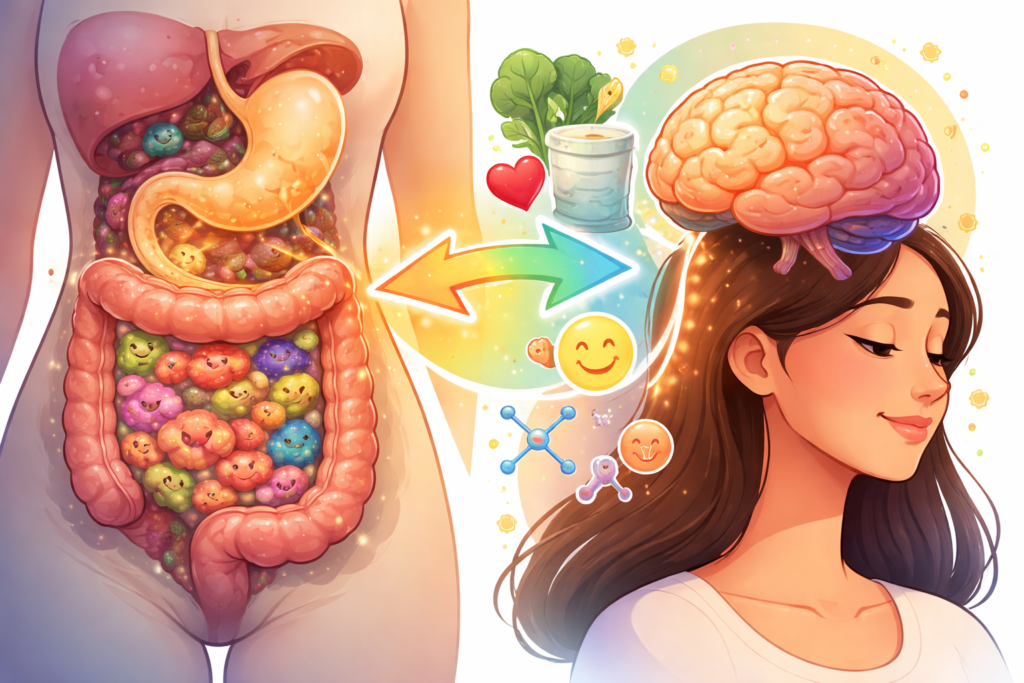
Can Gut Bacteria Calm the Mind?
For a long time, mental health and digestive health were treated as separate worlds. Anxiety was thought to belong to the brain. Gut problems belonged to the digestive system. But science has been steadily rewriting that story. A growing body of research suggests that the trillions of microbes living in our intestines may help shape how we respond to stress, how inflamed our bodies become, and even how anxious we feel. This connection is often called the microbiota-gut-brain axis: a two-way communication system linking the gut, the immune system, hormones, nerves, and the brain.
A 2017 review in Brain, Behavior, and Immunity ( 66: 9–17) laid out the big picture: gut microbes may influence mood and behavior through immune signaling, the vagus nerve, stress hormones, and microbial metabolites such as short-chain fatty acids.
A newer 2024 study in Nutrients (16, 3209. https://doi.org/10.3390/nu16183209) pushed that idea further by testing specific probiotic strains in stressed mice. Its results suggest that not all probiotics are equal—and that one strain of Limosilactobacillus reuteri may be especially promising in reducing anxiety-like behavior and intestinal symptoms.
Together, the two papers tell a compelling story: the gut-brain link is real, biologically plausible, and increasingly testable. But they also remind us that this field is still developing, and much of the strongest evidence still comes from animals rather than humans.
The gut is not just for digestion
The human gastrointestinal tract is home to an enormous microbial ecosystem: bacteria, viruses, fungi, and other microorganisms that help digest food, regulate metabolism, train the immune system, and maintain the gut barrier. The 2017 review argues that these microbes do much more than assist digestion. They are part of a broader signaling network that communicates with the central nervous system. This communication can happen through several routes:
- The vagus nerve, which carries signals between the gut and the brain
- The immune system, through inflammatory molecules such as cytokines
- Stress hormones, especially the hypothalamic-pituitary-adrenal (HPA) axis
- Microbial metabolites, including short-chain fatty acids
- Neurotransmitter-related pathways, involving serotonin, GABA, and brain-derived neurotrophic factor (BDNF)
In other words, the gut may influence the brain not by magic or metaphor, but through chemistry, neural signaling, and immune regulation. This helps explain why chronic stress can affect the digestive system—and why digestive disturbances may, in turn, affect mood and behavior.
Stress can disrupt the gut, and the gut can amplify stress
One of the central ideas in the 2017 review is that the relationship between microbes and mental health is bidirectional.
Stress can reshape the gut microbiota. At the same time, changes in the gut microbiota can alter how the body handles stress.
Animal studies summarized in the review show that stress can reduce beneficial bacteria and increase inflammatory responses. Germ-free mice—animals raised without normal gut microbes—often show abnormal stress responses, including exaggerated activation of the HPA axis. Some of these effects can be partly reversed when the animals are colonized with certain microbes, especially early in life.
This is a striking finding because it suggests that gut microbes are not merely passengers in the body. They may help “program” parts of the stress response system.
The review also highlights another key point: gut microbes may shape levels of important compounds related to mental health, including:
- Tryptophan, a precursor to serotonin
- Serotonin, much of which is produced in the gut
- GABA, a major inhibitory neurotransmitter involved in anxiety regulation
- BDNF, a protein important for brain plasticity and resilience
These pathways give scientists plausible mechanisms for how changes in gut bacteria could influence anxiety and depression.
From theory to testing:
While the 2017 review maps the territory, the 2024 study asks a more specific question: Can a carefully selected probiotic strain reduce stress-related anxiety-like behavior and gut symptoms? Researchers isolated 11 strains of Limosilactobacillus reuteri from healthy people and compared them genetically and physiologically. This matters because probiotic effects are often strain-specific. Two bacteria may belong to the same species but still behave very differently.
After screening the strains, the researchers selected two candidates—especially one called WLR01—for testing in two mouse stress models:
- Sleep deprivation (SD), used to model stress-related behavioral and inflammatory changes
- Water avoidance stress (WAS), used to model anxiety-like behavior and intestinal dysfunction
The results were notable.
In stressed mice, WLR01 improved several outcomes:
- reduced anxiety-like behavior in behavioral tests
- improved memory and cognitive performance
- reduced some inflammatory markers
- improved intestinal barrier-related markers
- reduced visceral hypersensitivity and stress-related bowel symptoms
- shifted the gut microbiota toward a healthier profile
The researchers concluded that WLR01 showed particular promise as a probiotic candidate for anxiety-like behavior and intestinal symptoms.
Why one probiotic may work better than another
One of the most important contributions of the 2024 paper is its emphasis on strain specificity.
“Take probiotics” sounds simple, but scientifically it is not. Different strains can vary in:
- growth rate
- tolerance to acid and bile
- metabolite production
- carbohydrate metabolism
- genomic traits
- possible effects on inflammation and host physiology
In this study, WLR01 stood out partly because it showed favorable biological features in the lab before it ever entered an animal experiment. It grew quickly, tolerated acidic and bile-rich conditions well, and produced metabolites that may be relevant to gut and brain health. This fits well with the broader message of the 2017 review: microbial effects on the brain are likely mediated through specific biological pathways, not vague notions of “good bacteria.” If probiotics are going to be used meaningfully in mental health, the field will likely need to move away from generic claims and toward well-characterized strains with known mechanisms.
The inflammation connection
A major bridge between the two articles is inflammation.
The 2017 review describes how microbial cell-wall components and immune signaling molecules can influence the brain. Pro-inflammatory cytokines such as IL-6 and other immune mediators may alter mood and behavior either indirectly through neural routes or more directly through effects on the brain.
The 2024 study adds experimental support to this concept. In sleep-deprived mice, WLR01 reduced inflammatory markers and was associated with changes in the NLRP3 inflammasome pathway, a molecular system involved in inflammation. In the water-avoidance stress model, the strain also appeared to affect the HPA axis and improve markers of gut barrier integrity such as occludin and ZO-1.
Taken together, these findings suggest a layered model:
- stress disrupts the gut and immune balance
- gut disruption promotes inflammation and barrier dysfunction
- those changes may influence the brain and behavior
- certain probiotic strains may partially interrupt that cycle
This does not mean anxiety is “caused by the gut” in any simple sense. Mental health is shaped by genetics, life experiences, environment, sleep, social context, and many biological systems. But the gut may be one important piece of that puzzle.
The gut barrier may matter more than we thought
Another recurring theme is the intestinal barrier—the lining that helps keep harmful substances from leaking out of the gut into the rest of the body. The 2017 review notes that stress hormones and immune activity can alter gut permeability. The 2024 study found that stressed mice showed signs of impaired barrier function, while WLR01 helped restore markers associated with barrier integrity.
Why does that matter for mental health?
Because a weakened gut barrier may expose the immune system to more microbial products, potentially increasing inflammation. And inflammation, in turn, has long been implicated in anxiety, depression, and stress-related illness.
This idea does not fully explain mental disorders, but it offers another biologically coherent route by which the gut and brain may influence each other.
Promising, yes—but still early
These findings are exciting, but they should not be oversold. The 2017 article is a review, which means it synthesizes existing evidence rather than proving one direct cause. The 2024 article is a mouse study, not a human clinical trial. Mouse models are useful, but they are not the same as human anxiety disorders.
A few important cautions:
- Animal behavior is not identical to human emotion. “Anxiety-like behavior” in mice is informative, but not equivalent to clinical anxiety in people.
- Not all probiotics work the same way. Effects are likely strain-specific.
- Human microbiomes are more complex than lab mouse microbiomes.
- Mental health conditions are multifactorial. Gut microbes are unlikely to be the sole explanation.
- The 2024 study itself points out the need for clinical validation in humans.
So while this research supports the possibility of targeted “psychobiotics”—microbes that may benefit mental health—it does not justify blanket claims that yogurt or supplements can cure anxiety.
What these studies really tell us
Together, these papers suggest three important shifts in how science is thinking about mental health.
1. The gut and brain are deeply connected
This is no longer a fringe idea. There are credible biological pathways linking microbes, immunity, hormones, and the nervous system.
2. Mechanism matters
The field is moving beyond broad claims about “healthy gut flora” toward more specific questions: which strains, which metabolites, which pathways, and under what conditions?
3. Future treatments may be more personalized
If strain-specific microbes can influence stress responses, inflammation, or gut symptoms, future interventions may be tailored to a person’s biology rather than relying on one-size-fits-all probiotics.
The bigger picture
The most interesting part of this story is not that gut bacteria are replacing psychology or psychiatry. It is that biology is becoming more integrated. The brain is not isolated from the body. Stress is not only “in the mind.” And the gut is not just a digestive tube. It is an active biological interface where microbes, diet, immune function, and neural signaling meet.
The 2017 review gave the field a framework for understanding how microbes could influence anxiety and depression. The 2024 study adds a more practical layer by showing that one carefully selected Limosilactobacillus reuteri strain, WLR01, can improve stress-related behaviors and gut symptoms in mice. That does not mean we have a probiotic cure for anxiety.
But it does mean the old boundary between mental health and gut health is becoming harder to defend. And that may change how we think about both.