🌱 Healthy Soil, Healthy Plants: Rethinking Agriculture from the Ground Up
What if the secret to better crops wasn’t more chemicals or more machinery—but healthier soil?
That’s exactly what conservation agriculture is all about. It challenges the way we’ve traditionally farmed and asks a simple but powerful question: What happens when we work with nature instead of against it?
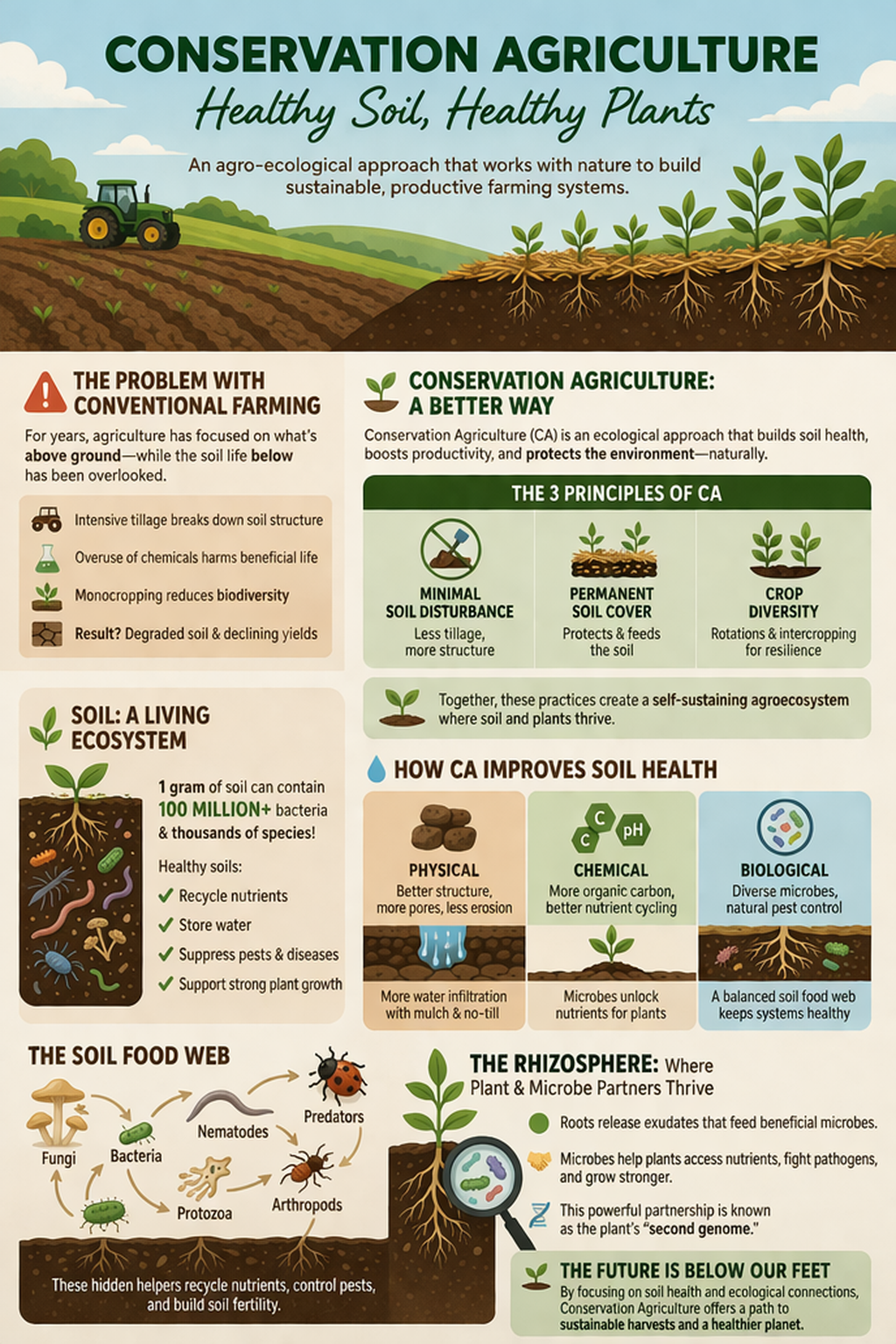
🌾 The Problem with Conventional Farming
For decades, conventional agriculture has focused mostly on what we can see—plants above the ground. But here’s the catch:
👉 We’ve largely ignored what’s happening below the surface
Soil isn’t just dirt—it’s a living, breathing ecosystem. And when we disrupt it through intensive tillage, overuse of chemicals, and monocropping, we create a ripple effect:
- Loss of soil structure
- Decline in organic matter
- Poor water retention
- Unhealthy microbial communities
In short, we weaken the very foundation that plants depend on.
🌍 Enter Conservation Agriculture
Conservation agriculture (CA) flips the script. Instead of forcing productivity, it builds it—naturally.
At its core, CA is about working with ecological processes to create sustainable, productive farming systems.
The 3 Golden Principles of CA:
- Minimal soil disturbance (less tillage)
- Permanent soil cover (crop residues or cover crops)
- Crop diversity (rotations and intercropping)
These may sound simple, but together they create powerful, long-term benefits.
🧬 Soil: The Living Engine of Agriculture
Here’s something fascinating:
👉 Just 1 gram of soil can contain over 100 million bacteria and thousands of species.
That’s not dirt—that’s a biological powerhouse.
Healthy soils:
- Recycle nutrients
- Improve water retention
- Suppress pests and diseases
- Support plant growth through symbiotic relationships
In fact, soil health is so critical that losing just a small amount can take hundreds of years to recover.
⚠️ The Downward Spiral of Poor Soil Health
When soil is overworked, things start to unravel:
- Tillage increases oxygen → speeds up organic matter breakdown
- Organic matter declines → less food for microbes
- Microbial life declines → weaker soil structure
- Soil compacts → poor drainage and root growth
And just like that, productivity drops. It’s a vicious cycle—but thankfully, it can be reversed.
💧 How Conservation Agriculture Fixes the Problem
CA improves soil in three major ways:
1. 🧱 Physical Improvements
- Better soil structure and aggregation
- Increased porosity (more air + water movement)
- Reduced erosion and runoff
💡 Example: Fields with mulch and no-till practices absorb significantly more water than tilled fields.
2. ⚗️ Chemical Improvements
- Increased soil organic carbon
- Better nutrient cycling (especially nitrogen)
- Improved pH balance
Microorganisms play a huge role here—breaking down organic matter and making nutrients available to plants.
3. 🦠 Biological Improvements
This is where things get really interesting.
Healthy soils support:
- Beneficial bacteria and fungi
- Natural pest control systems
- Symbiotic plant relationships
Think of it as building a self-regulating ecosystem underground.
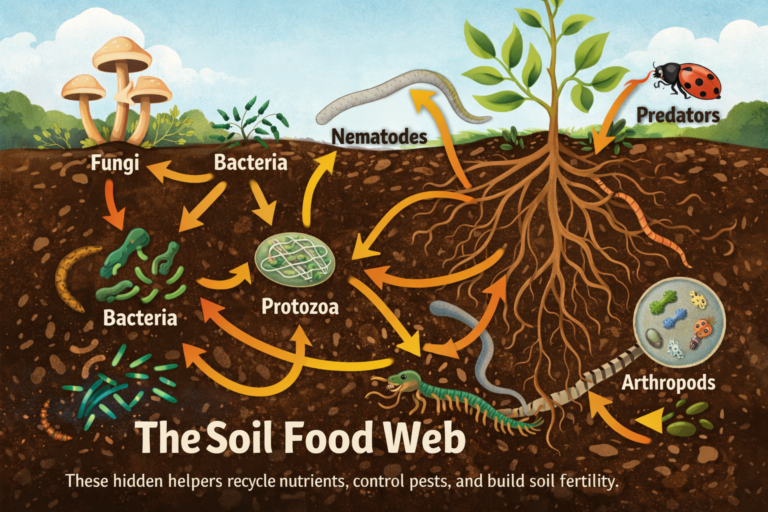
🌐 The Hidden World: Soil Food Webs
Beneath your feet is a complex food web involving:
- Microbes
- Fungi
- Insects
- Predators
These organisms interact in what scientists call multitrophic systems—basically, layered food chains that keep everything in balance.
👉 When this system is healthy, it naturally:
- Controls pests
- Enhances nutrient availability
- Supports plant resilience
🌿 The Rhizosphere: Where the Magic Happens
Right around plant roots is a hotspot called the rhizosphere—and it’s buzzing with activity.
Plants release compounds called root exudates, which:
- Feed microbes
- Attract beneficial organisms
- Influence soil chemistry
In return, microbes:
- Help plants absorb nutrients
- Protect against pathogens
- Stimulate growth
Some scientists even call this microbial community the plant’s “second genome.”
🛡️ Nature’s Defense System: Disease-Suppressive Soils
One of the most powerful benefits of healthy soil? 👉 It can naturally suppress plant diseases
This happens in two ways:
- General suppression: overall microbial activity keeps pathogens in check
- Specific suppression: certain microbes directly attack harmful organisms
For example, beneficial bacteria like Pseudomonas can produce natural antifungal compounds.
🌱 Biodiversity = Productivity
Diverse systems are stronger systems.
When you increase biodiversity:
- Beneficial organisms thrive
- Harmful species are kept in check
- Productivity improves
This is why practices like intercropping and cover cropping are so effective—they create more interactions and stability.
🌼 The Power of Plant Communication
Plants aren’t passive—they communicate.
Through chemicals (like volatile organic compounds), they can:
- Signal distress
- Attract beneficial insects
- Influence microbial communities
Even more fascinating?
What happens above ground (like insect feeding) can affect what happens below ground, and vice versa.
🌾 Harnessing Natural Chemistry: Allelopathy
Some plants release chemicals that:
- Suppress weeds
- Inhibit pathogens
- Influence surrounding plants
This process, called allelopathy, can be used strategically in:
- Cover cropping
- Intercropping systems
It’s nature’s way of managing competition.
🤝 Beneficial Microbes: Agriculture’s Silent Partners
Certain microbes actively promote plant growth:
Plant Growth-Promoting Rhizobacteria (PGPR)
- Improve nutrient uptake
- Enhance soil structure
- Help plants resist stress
Plant Growth-Promoting Fungi (PGPF)
- Break down organic matter
- Protect against pathogens
- Stimulate plant defenses
A standout example is Trichoderma, a fungus widely used in biocontrol.
🔮 The Future: Farming with the Phytobiome
Modern agriculture is starting to embrace a bigger picture—the phytobiome.
This includes:
- Plants
- Microbes
- Soil
- Insects
- Environment
All interacting as one system.
The future lies in:
- Understanding these interactions
- Using tools like genomics
- Designing systems that work with biology, not against it
🌍 Final Thoughts
If there’s one takeaway, it’s this:
👉 Healthy soil is the foundation of everything
By focusing on soil health and ecological interactions, conservation agriculture offers a path toward:
- Sustainable productivity
- Climate resilience
- Long-term food security
And perhaps most importantly—it reminds us that the smallest organisms beneath our feet may hold the biggest answers.