
🌿 Introduction
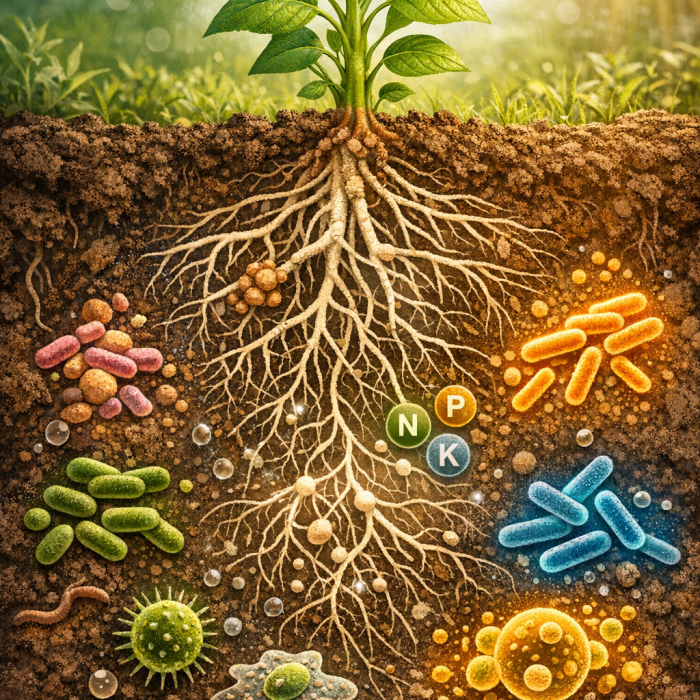
Microorganisms dominate nearly every habitat on Earth, especially soil ecosystems both above and below ground. Around plants, these microscopic communities form what is known as the plant microbiome—a dynamic network of organisms living in and around roots, leaves, and internal tissues.
These microbes exist in three key zones:
Rhizosphere (root zone)
Endosphere (internal tissues)
Phyllosphere (leaf surfaces)
Some microbes are harmful, but many are neutral or highly beneficial. In fact, plants actively recruit helpful microbes to improve their growth, nutrition, and resistance to disease.
🌾 What Are Microbial Consortia?
Microbial consortia are carefully selected combinations of beneficial microorganisms designed to work together to improve plant health.
Originally popularised through the concept of Effective Microorganisms (EM), these formulations:
Enhance soil biodiversity
Improve nutrient availability
Protect plants from pathogens
Boost overall crop productivity
Unlike single microbial strains, consortia combine multiple species to create synergistic effects.
⚠️ Why Agriculture Needs Microbial Solutions
Modern agriculture faces serious challenges:
🌍 Environmental Issues
Soil degradation from overuse of fertilisers
Water pollution and eutrophication
Loss of biodiversity
🧪 Chemical Dependency
Overuse of pesticides and fungicides
Health risks from chemical residues
Pathogen resistance to chemicals
📉 Soil Health Decline
Acidification
Heavy metal contamination
Reduced microbial diversity
👉 Microbial inoculants offer a natural, sustainable alternative.
🌱 The Plant–Microbe Connection
🌿 Rhizosphere
The rhizosphere is a hotspot of microbial activity around plant roots.
Fueled by root exudates (carbon-rich compounds)
Hosts dense microbial populations
Influences nutrient uptake and disease resistance
Plants can actively “select” beneficial microbes by releasing specific compounds.
🌿 Endosphere
Inside plant tissues, microbes known as endophytes:
Enhance plant growth and vigor
Improve stress tolerance
Produce bioactive compounds
These microbes act like an internal support system for plants.
🛡️ How Microbes Protect Plants
🦠 Disease Suppression
Beneficial microbes:
Produce antibiotics
Compete with pathogens
Parasitise harmful organisms
🌿 Induced Immunity
They trigger plant defense systems like:
ISR (Induced Systemic Resistance)
SAR (Systemic Acquired Resistance)
🌾 Boosting Plant Growth Naturally
Microbial consortia improve plant nutrition through:
🔬 Nutrient Cycling
Nitrogen fixation
Phosphorus solubilisation
Mineral mobilisation
🌿 Root Expansion
Mycorrhizal fungi extend root systems, increasing nutrient uptake.
🌱 Hormone Production
Microbes produce plant hormones like:
Auxins
Cytokinins
Gibberellins
👉 Result: Faster growth, stronger plants, higher yields.
🧫 Key Beneficial Microbes
Bacillus spp.
Disease suppression
Stress tolerance
Yield improvement
Pseudomonas spp.
Antibiotic production
Nutrient cycling
Immune activation
Rhizobium spp.
Nitrogen fixation
Essential for legumes
Azospirillum spp.
Growth promotion
Hormone production
Mycorrhizal Fungi (Glomus spp.)
Root expansion
Improved nutrient uptake
🌍 Why Consortia Work Better Than Single Microbes
Single microbial strains often struggle in real-world conditions due to:
Competition with native microbes
Environmental variability
Limited functionality
👉 Microbial consortia overcome this by:
Combining multiple beneficial traits
Providing synergistic effects
Delivering more consistent results
🚜 How Farmers Apply Microbial Inoculants
🌱 Seed treatment (bio-priming)
🌍 Soil application (granules/liquids)
🌿 Root dipping (nursery plants)
💧 Foliar sprays
Each method helps introduce beneficial microbes at different growth stages.
🌾 Microbes vs Chemical Inputs
| Microbial Solutions | Chemical Inputs |
|---|---|
| Eco-friendly | Environmental harm |
| Improve soil health | Degrade soil over time |
| Safe for humans | Potential health risks |
| Sustainable | Short-term solutions |
👉 Best results often come from combining microbes with reduced fertiliser use.
🌱 The Future of Agriculture
Microbial consortia represent a powerful shift toward regenerative agriculture.
With advances in:
Synthetic microbiomes
Precision agriculture
Biological formulations
We are moving toward farming systems that are:
More sustainable
More resilient
More productive
✅ Conclusion
Microbial consortia offer a transformative solution to many of agriculture’s biggest challenges. By harnessing the natural power of beneficial microorganisms, we can reduce reliance on chemicals, restore soil health, and improve crop productivity in a sustainable way.