The Original Farmers:
When we think about farming, we usually picture tractors, wheat fields, and human ingenuity. But long before the first human planted a seed, insects had already mastered agriculture. Some ants cultivate fungal gardens. Certain termites grow fungal crops in underground chambers. Even tiny beetles carry fungal spores in specialized pockets and plant them inside trees.
A remarkable scientific review published in the Annual Review of Entomology reveals just how widespread and sophisticated these insect-fungus partnerships are. Far from being simple associations, they represent some of the most successful examples of cooperation in nature.
A Partnership 400 Million Years in the Making
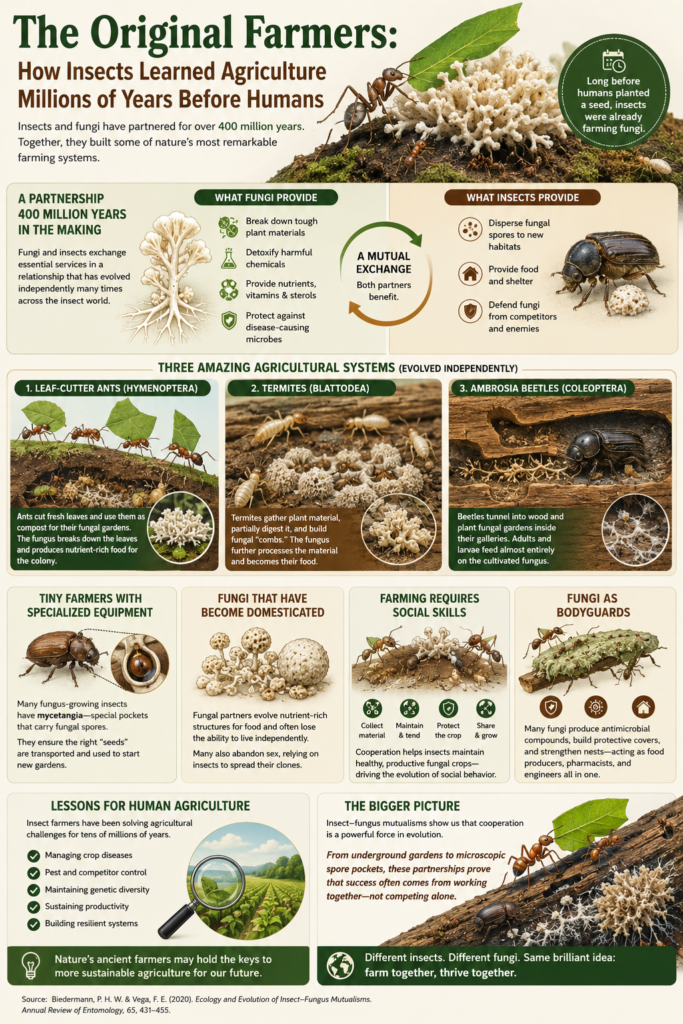
Insects and fungi have shared Earth’s ecosystems for more than 400 million years. Over that immense span of time, the two groups have evolved countless interactions—some harmful, some neutral, and some extraordinarily beneficial. The most fascinating of these are mutualisms: relationships in which both partners benefit. In these partnerships, insects and fungi essentially trade services.
Fungi provide food, help break down tough plant materials, detoxify harmful chemicals, and even protect insects from disease-causing microbes. In return, insects transport fungal spores to new habitats, provide food and shelter for the fungi, and defend them against competitors. The result is a biological alliance that has evolved independently dozens of times across the insect world.
Why Insects Need Fungi
Many insects feed on materials that are notoriously difficult to digest.
Wood, bark, leaves, and plant sap contain plenty of carbon but very little nitrogen, phosphorus, and other nutrients that animals need to grow. Wood is particularly challenging—it’s essentially a nutrient-poor fortress built from cellulose, lignin, and defensive chemicals.
Fungi possess an extraordinary toolkit of enzymes capable of breaking down these materials.
They can:
- Digest cellulose and other plant polymers
- Neutralize toxic plant chemicals
- Concentrate nutrients from large areas
- Produce vitamins and sterols required by insects
In essence, fungi function as external digestive systems. Instead of trying to digest wood themselves, some insects let fungi do the hard work and then consume the fungal growth. This strategy allows insects to exploit food sources that would otherwise be inaccessible.
The Rise of Insect Agriculture
The best-known insect farmers are leaf-cutter ants.
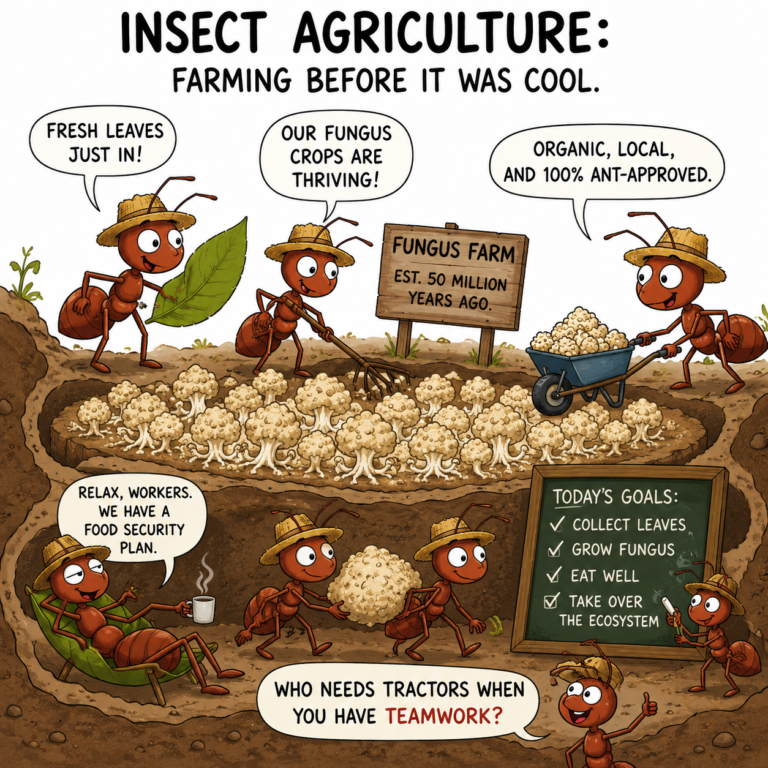
These famous insects harvest fresh leaves, not because they eat the leaves directly, but because they use them as compost for their fungal crops. The fungus breaks down the plant material and produces nutrient-rich structures that feed the colony.
Termites independently evolved a similar system.
Workers gather plant material, partially digest it, and construct fungal “combs” that serve as growth chambers. The cultivated fungus further processes the plant matter and becomes food for the termites.
Then there are ambrosia beetles—tiny wood-boring insects that tunnel into trees and plant fungal gardens inside their galleries. Adults and larvae feed almost entirely on these fungi.
Remarkably, these three agricultural systems evolved independently, making them one of the clearest examples of convergent evolution in nature. Different insects arrived at the same solution: farming fungi works.
Tiny Farmers with Specialized Equipment
Agriculture requires reliable seed storage and transport. Insects solved this problem millions of years ago. Many fungus-growing insects possess specialized structures called mycetangia—tiny pockets designed specifically for carrying fungal spores. When a beetle leaves one tree and colonizes another, it carries its fungal crop with it. Upon arrival, the beetle inoculates the new habitat and starts a fresh garden. Some of these structures are astonishingly sophisticated. Certain beetle mycetangia are highly selective, carrying only the correct fungal partner while excluding unwanted species. Nature invented precision agriculture long before humans did.
Fungi That Have Become Domesticated
Just as crops have changed under human domestication, fungal partners have evolved traits that make them better suited to life with insects. Many produce specialized nutrient-rich structures that insects eat. These structures are packed with enzymes, proteins, and nutrients, making them ideal food sources. Over evolutionary time, some fungal partners became so dependent on their insect hosts that they lost the ability to live independently.
Others reduced or abandoned sexual reproduction altogether, relying instead on insects to spread their clones from one generation to the next. This level of dependence resembles the relationship between humans and domesticated crops. Modern maize, for example, cannot easily survive without people. Likewise, some insect-cultivated fungi cannot survive without their insect farmers.
Farming Requires Social Skills
One of the most surprising findings is the connection between fungus farming and social behavior. Maintaining a fungal garden is hard work. The crop must be protected from pests and diseases. New material must be added continuously. Temperature and humidity often need regulation. These challenges favor cooperation.
In ants and termites, complex social systems evolved alongside fungal agriculture. Workers specialize in gardening, nest maintenance, defense, and food collection. Even in beetles and flies, researchers see simpler forms of cooperation associated with fungal cultivation.
In many cases, protecting the crop may have been a major force driving the evolution of social behavior itself.
Fungi as Bodyguards
The benefits of fungal partnerships extend far beyond nutrition. Many fungi produce antimicrobial compounds that suppress harmful bacteria and competing fungi. Some build protective coverings around insects, shielding them from predators, parasites, and disease. Others reinforce insect nests or galls, creating stronger structures that are difficult for enemies to penetrate. In some systems, fungi function simultaneously as food producers, pharmacists, and construction engineers.
Lessons for Human Agriculture
Perhaps the most intriguing aspect of insect agriculture is its longevity. Human agriculture is roughly 12,000 years old. Some insect-fungus farming systems are tens of millions of years old.
Over those vast timescales, insect farmers have faced many of the same challenges that confront modern agriculture:
- Crop diseases
- Pest management
- Maintaining genetic diversity
- Protecting crops from competitors
- Sustaining productivity across generations
Researchers believe that studying these ancient farming systems could provide insights into disease management, biological control, and sustainable agriculture. After all, if termites and ants have been running successful agricultural enterprises for tens of millions of years, they may have something to teach us.
The Bigger Picture
The story of insect-fungus mutualisms is ultimately a story about cooperation. Evolution is often portrayed as relentless competition, but nature is equally shaped by collaboration. Across forests, grasslands, and soils, insects and fungi have repeatedly discovered that working together can unlock opportunities neither partner could achieve alone.
From leaf-cutter ants tending underground gardens to beetles carrying fungal spores in microscopic pockets, these partnerships demonstrate one of evolution’s most powerful lessons:
Success doesn’t always come from competing harder. Sometimes it comes from finding the right partner.
And in the case of insects and fungi, that partnership helped create some of the oldest and most successful agricultural systems on Earth.