
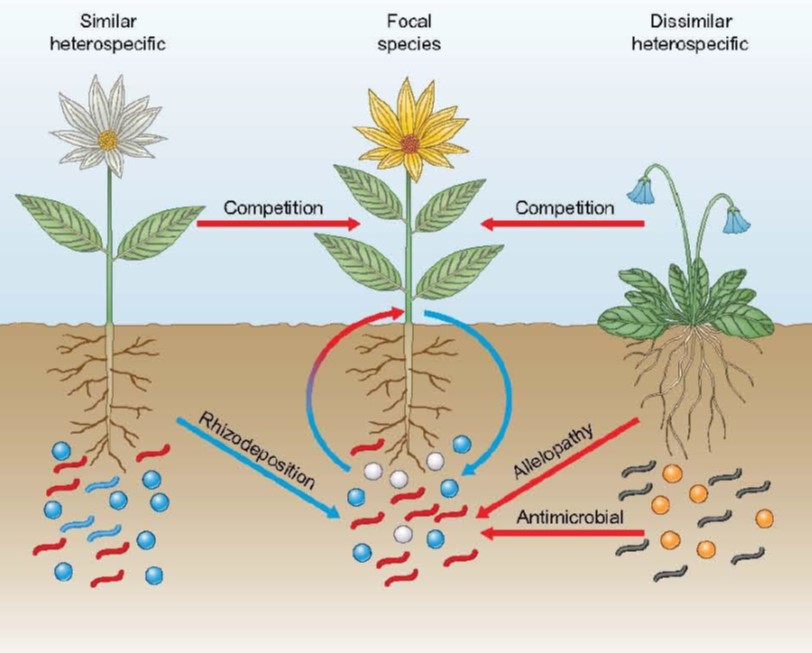
Plant–soil feedback (PSF) is the two-way interaction between plants and the soil they grow in, where plants change the soil, and those changes in turn affect future plant growth—often the same species or new ones.
In simple terms:
Plants shape the soil, and the soil then “remembers” and responds to those plants.
How it works:
1. Plants modify the soil
As plants grow, they influence the soil through:
- Root exudates (sugars, acids, and chemicals released by roots)
- Leaf litter and dead roots
- Microbial partnerships (especially bacteria and fungi)
- Nutrient uptake patterns
This changes the soil’s chemistry and its microbial community.
2. The soil feeds back to plants
When a plant (or a new plant) grows in that modified soil, it experiences effects such as:
- Better or worse nutrient availability
- More or fewer disease-causing organisms
- Changes in beneficial microbes like mycorrhizal fungi
- Altered soil structure and water retention
This “feedback” can either help or harm plant growth.
Positive vs negative feedback
🌱 Positive plant–soil feedback
The soil changes benefit future plants, often the same species.
Example:
- Legumes enrich soil with nitrogen-fixing bacteria
- Next plants grow faster due to increased nitrogen
This can lead to:
- Healthy plant communities
- Strong dominance of certain species
⚠️ Negative plant–soil feedback
The soil changes reduce growth of the same plant species over time.
Example:
- A plant accumulates species-specific soil pathogens
- Its own seedlings perform poorly in that soil
This leads to:
- Natural control of over-dominant species
- Increased biodiversity (new species can outcompete the old ones)
Why it matters in nature
Plant–soil feedback helps explain:
- Why forests and grasslands maintain diversity
- Why crops often need rotation in agriculture
- Why some invasive species succeed or fail
- How ecosystems recover after disturbance
It’s one of the key mechanisms behind ecosystem balance underground.
A useful way to think about it
Imagine soil as a living memory system:
- Every plant “writes” information into the soil
- Microbes and chemistry store that information
- The next plant reads it—and responds
So instead of soil being passive, it’s an active participant in shaping plant life.
Plant–soil feedback becomes especially important when you connect it to farming and soil microbes, because agriculture is basically a managed version of this natural feedback loop.
Plant–soil feedback in farming systems
In natural ecosystems, plant–soil feedback tends to balance itself over time. In agriculture, however, we often simplify the system by planting the same crop repeatedly. That amplifies certain feedback effects—both good and bad.
1. Monocropping and negative feedback
When the same crop is grown in the same soil year after year:
- Pathogens build up (fungi, nematodes, bacteria that specialise in that crop)
- Beneficial microbes decline because diversity is reduced
- Soil nutrients become unbalanced
- The plant effectively “ages” its own soil
This is why continuous maize, wheat, or tomato production often leads to declining yields unless inputs (fertiliser, pesticides) increase.
This is a classic negative plant–soil feedback loop in action.
2. Crop rotation: breaking the cycle
Crop rotation works because it resets the soil feedback system.
For example:
- A cereal crop uses certain nutrients and supports specific microbes
- A legume crop (like beans or clover) adds nitrogen through nitrogen-fixing bacteria
- A brassica crop may suppress certain soil pathogens
By rotating crops, farmers:
- Interrupt pathogen cycles
- Promote microbial diversity
- Balance nutrient use and replenishment
This reduces negative feedback and strengthens positive feedback.
3. Compost and organic matter: feeding the microbial engine
Adding compost is like giving soil microbes a diverse food source, which shifts feedback toward positive outcomes.
Compost:
- Introduces beneficial microbes directly
- Feeds decomposer bacteria and fungi
- Increases soil organic carbon (energy for microbial life)
- Buffers harmful soil chemistry changes
This creates a richer microbial community that tends to support healthier plant growth.
4. Mycorrhizal fungi: the underground partnership
One of the most important players in plant–soil feedback is mycorrhizal fungi.
These fungi form symbiotic relationships with plant roots:
- Plants give fungi sugars from photosynthesis
- Fungi deliver water and nutrients (especially phosphorus and micronutrients)
In farming systems:
Positive effects
- Better drought resistance
- Improved nutrient uptake
- Increased soil aggregation (better structure)
Problems with disruption
- Excessive tillage breaks fungal networks
- High phosphorus fertiliser can reduce plant reliance on fungi
- Fallow soils lose fungal continuity
So farming practices directly influence whether this feedback loop is strengthened or weakened.
5. Rhizosphere bacteria: the chemical negotiators
The rhizosphere is the thin zone of soil directly influenced by roots. It is one of the most biologically active zones on Earth.
Here, bacteria:
- Solubilise phosphorus
- Fix nitrogen
- Produce growth hormones
- Compete with or suppress pathogens
Plants actively “recruit” these microbes using root exudates.
In agriculture:
- Healthy rhizosphere communities = stronger positive feedback
- Disrupted communities = more disease and lower nutrient efficiency
6. Regenerative agriculture: designing positive feedback
Modern regenerative farming tries to intentionally steer plant–soil feedback in a positive direction.
Key practices include:
- Cover cropping → keeps living roots in soil year-round
- Reduced tillage → preserves fungal networks
- Diverse rotations → prevents pathogen dominance
- Organic amendments → feeds microbial diversity
- Minimal synthetic disruption → avoids collapsing microbial communities
The goal is not just to grow plants, but to train the soil ecosystem to become self-reinforcing and fertile.
The BIG picture
Plant–soil feedback is essentially the memory and response system of agriculture:
- Plants shape the soil community
- Soil microbes and chemistry respond
- That response influences the next generation of plants
Farming success depends on whether that loop becomes:
- 🔴 Degrading (negative feedback) → declining fertility, rising disease
- 🟢 Regenerative (positive feedback) → improving soil health over time