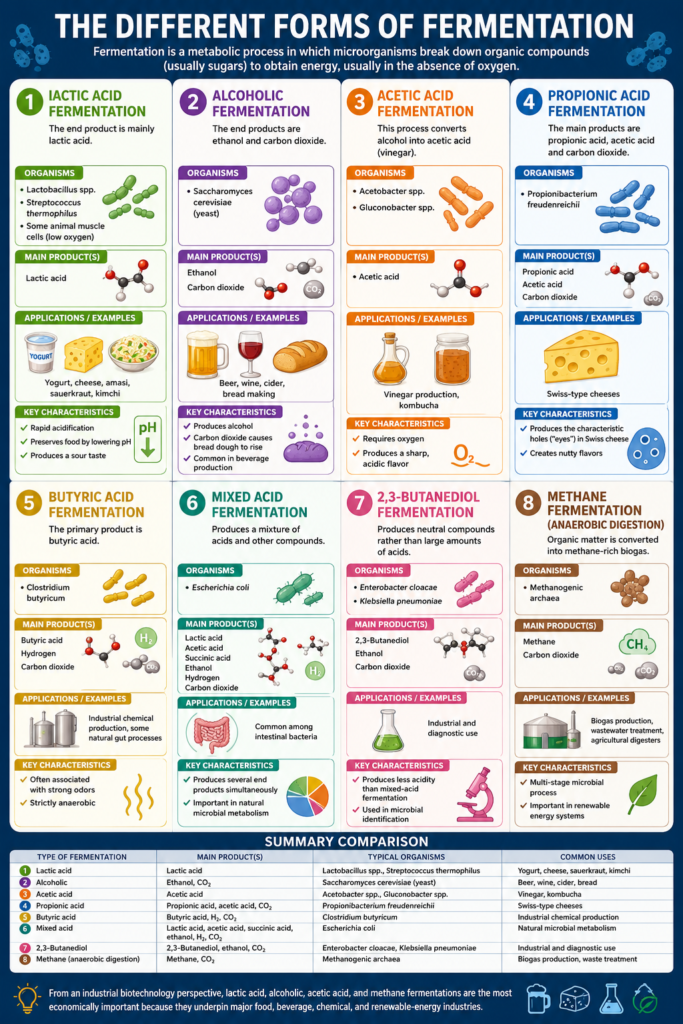

A useful way to understand fermentation is to think of it as microbial chemical engineering at a microscopic scale.
The Fermentation Cell as a Chemical Plant
In a conventional chemical factory:
- Raw materials enter the plant.
- Reactors convert them into products.
- Engineers control temperature, pH, mixing, and flow rates.
- Valuable products are harvested.
The Microbial Factory Floor
A bacterium or yeast cell contains thousands of enzymes acting as highly specialized chemical catalysts.
For example:
Glucose → Pyruvate → Ethanol + CO₂ during alcoholic fermentation, or
Glucose → Pyruvate → Lactic Acid during lactic acid fermentation.
Each enzyme performs a specific conversion step, creating a biochemical production line far more sophisticated than most industrial plants.
The Fermenter as a Bioreactor
Industrial fermentation vessels are essentially biological chemical reactors.
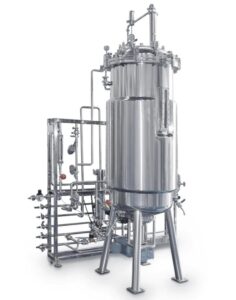
Engineers monitor:
- Temperature
- pH
- Oxygen levels
- Agitation
- Nutrient concentration
- Product formation
These are the same process variables managed in traditional chemical engineering.
Microbes as Self-Replicating Chemical Engineers
A remarkable difference is that microorganisms:
- Build their own catalysts (enzymes).
- Repair themselves.
- Reproduce.
- Adapt to changing conditions.
A chemical plant cannot manufacture more engineers while operating; microbes do exactly that.
Fermentation as Green Chemical Engineering
Many modern biotechnologies use fermentation to produce:
- Biofuels
- Organic acids
- Amino acids
- Pharmaceuticals
- Industrial enzymes
- Bioplastics
Instead of high temperatures and pressures, microbes often work under mild conditions:
- 20–40°C
- Atmospheric pressure
- Renewable feedstocks
This makes fermentation one of the most sustainable forms of manufacturing.
A Simple Analogy
Imagine millions of microscopic chemical engineers working inside tiny factories. They receive sugar deliveries, process them through intricate assembly lines of enzymes, and continuously manufacture products such as yogurt, beer, vinegar, antibiotics, or biogas. The fermenter is simply the industrial park that houses these microbial workers and provides them with ideal operating conditions.
This is why fermentation can be described as nature’s version of chemical engineering—a highly efficient, self-organizing manufacturing system driven by microorganisms.