
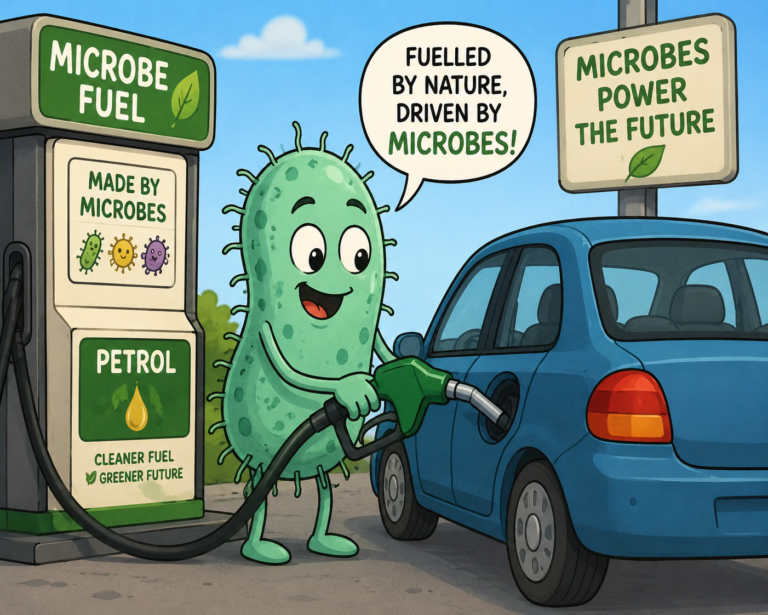
The war in Iran and the blockade of the Strait of Hormuz has pushed the cost of oil sky high and people all over the world feel it in their pockets when they put petrol in their cars. The big question on everybody’s mind is how much higher are these prices going to skyrocket and are there any alternatives to fossil fuels apart from electrica vehicles (EV’s)?
Microbes have significant potential to provide alternatives to fossil fuels, although they are unlikely to completely replace fossil fuels on their own in the near future. Instead, they are expected to be part of a broader renewable energy mix.
How Microbes Can Produce Fuel
Microorganisms such as bacteria, yeasts, algae, and archaea can convert renewable biological materials into fuels through fermentation and other metabolic processes.
1. Bioethanol
Yeasts, especially Saccharomyces cerevisiae, ferment sugars from crops or agricultural waste into ethanol.
Process:
Sugar → Ethanol + Carbon dioxide
Bioethanol is already blended with petrol in many countries.
2. Biogas (Methane)
Methanogenic archaea break down organic waste in the absence of oxygen.
Process:
Organic waste → Methane-rich biogas
extOrganicMatterightarrowCH4+CO2ext{Organic Matter} ightarrow CH_4 + CO_2extOrganicMatterightarrowCH4+CO2
Biogas can be used for:
- Electricity generation
- Cooking
- Heating
- Vehicle fuel after purification
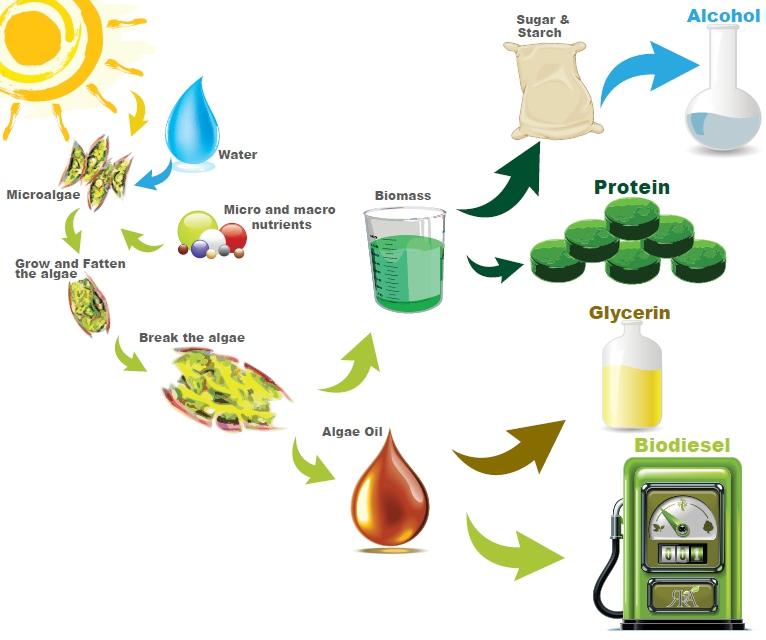
3. Biodiesel from Microalgae
Microalgae can accumulate large amounts of oils that can be converted into biodiesel.
Advantages:
- Much higher oil yield than most crops
- Can grow on non-arable land
- Can utilize wastewater and industrial CO₂
4. Biohydrogen
Certain bacteria and algae produce hydrogen gas using sunlight or organic matter.
Hydrogen is attractive because its combustion produces only water:
2H2+O2ightarrow2H2O2H_2 + O_2 ightarrow 2H_2O2H2+O2ightarrow2H2O
5. Advanced Biofuels
Scientists are engineering microbes to produce:
- Jet fuel substitutes
- Diesel-like hydrocarbons
- Sustainable aviation fuels
- Renewable chemicals traditionally made from petroleum
Companies are developing engineered bacteria that convert plant waste directly into liquid fuels.
Why Microbes Are Attractive
Microbial fuels can:
- Use renewable feedstocks
- Convert agricultural and food waste into energy
- Reduce greenhouse gas emissions
- Operate in circular economy systems
- Potentially capture carbon while producing fuel
Fermentation as Microbial Chemical Engineering
You can think of a microbial bioreactor as a miniature oil refinery:
| Fossil Fuel Refinery | Microbial Biorefinery |
|---|---|
| Uses crude oil | Uses biomass and waste |
| High temperature and pressure | Mild biological conditions |
| Chemical catalysts | Living microbial catalysts |
| Produces fuels and chemicals | Produces biofuels and bioproducts |
| Releases ancient carbon | Uses recently captured carbon |
Current Limitations
Microbial fuels still face challenges:
- Production costs can be high.
- Large land and water requirements for some feedstocks.
- Lower energy density than petroleum for some fuels.
- Scaling laboratory processes to industrial levels remains difficult.
The Future
Many experts believe the most important role for microbes will be:
- Producing sustainable aviation fuel.
- Converting agricultural and municipal waste into energy.
- Manufacturing renewable chemicals and plastics.
- Capturing carbon dioxide while generating fuels.
Microbes are unlikely to replace all fossil fuels, but they could become one of the most important technologies for producing low-carbon fuels and chemicals during the transition to a more sustainable energy system. They essentially act as tiny biological factories that convert sunlight, waste, and carbon dioxide into usable energy carriers.