The Amazing Mechanisms of Microbial Dispersal
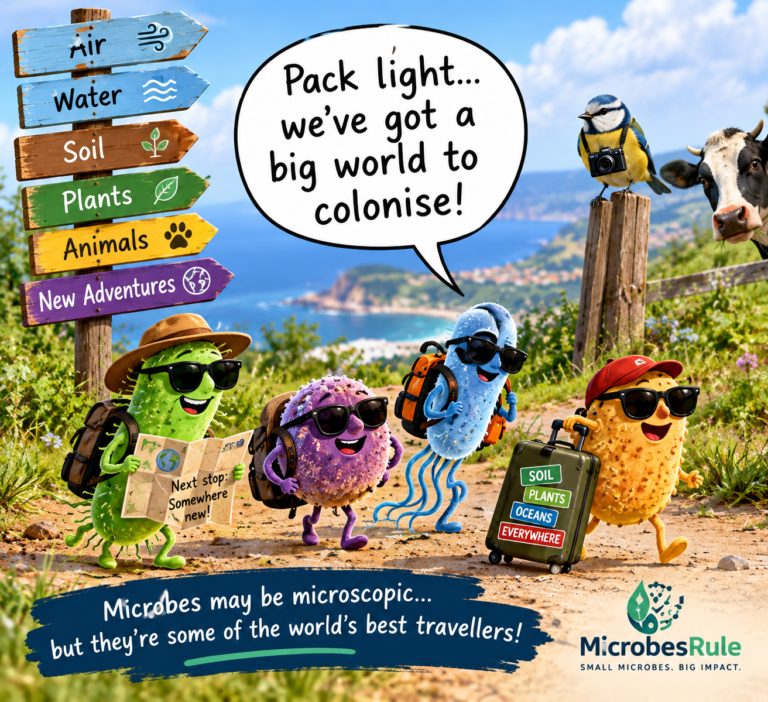
Microbes may be microscopic, but they are remarkably good travellers.
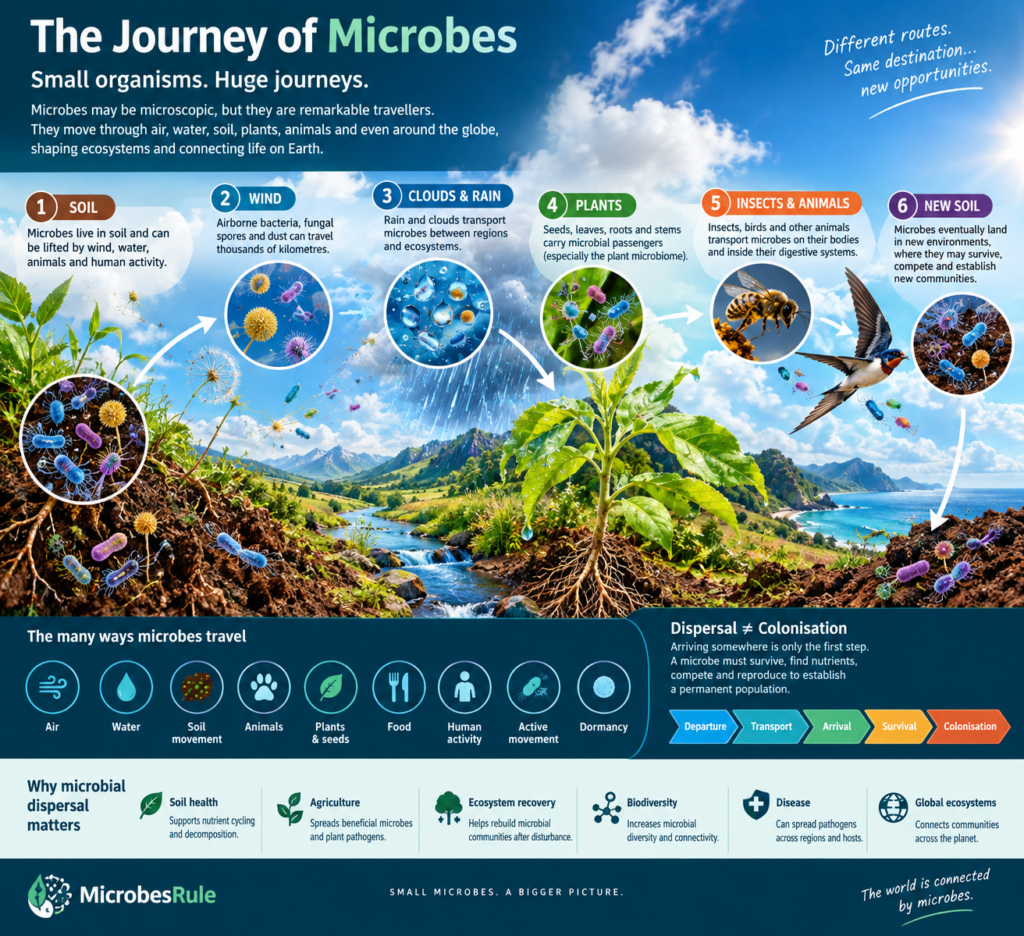
Every day, billions upon billions of bacteria, fungi and other microorganisms are being transported through the environment. They move through the atmosphere, rivers and oceans, across soil, between plants and animals—and even around the world with us.
Some microbes actively move under their own power. Others simply hitch a ride.
This movement is known as microbial dispersal, and it is fundamental to microbial ecology.
It helps determine where microorganisms occur, how microbial communities develop and how microorganisms colonise new environments. In fact, dispersal is one of the major processes involved in shaping microbial biogeography, alongside environmental selection, ecological drift and mutation.
But how exactly does a microorganism travel?
What is microbial dispersal?
Microbial dispersal is the movement of microorganisms—or their reproductive or dormant structures—from one location to another.
The journey can be surprisingly short.
A bacterium might move a few millimetres through a film of water in soil. A fungal spore might travel several kilometres through the atmosphere. Microorganisms carried by ocean currents, animals or human transport can potentially travel across continents.
But there is an important distinction:
Dispersal is not the same as colonisation.
Arriving somewhere new does not guarantee that a microorganism will survive there. A successful colonist must find suitable conditions, obtain nutrients, compete with resident microorganisms and reproduce. So microbial dispersal can be thought of as:
Departure → Transport → Arrival → Survival → Colonisation
That final step is often the hardest.
1. The atmosphere: microbes on the wind
Look up at the sky and you might think you are looking at an essentially microbial-free environment. You are not. The atmosphere contains bacteria, fungal spores and other biological particles. Air can connect ecosystems separated by enormous distances, making the atmosphere an important microbial dispersal pathway.
Fungal spores are particularly well suited to aerial dispersal. They are often tiny, lightweight and produced in enormous numbers. Once released, they can be carried by air currents until they encounter a suitable surface.
Some fungi have even evolved specialised mechanisms for launching spores into the surrounding air. The result is a microscopic world constantly raining down from the atmosphere. And it isn’t only fungi. Bacterial cells and other microbial particles can become attached to dust and aerosols and travel with them.
Dust: a microbial taxi
Dry soil is especially important. Strong winds can lift dust particles containing microorganisms into the atmosphere. Those particles can subsequently settle somewhere else. This creates a fascinating connection between distant ecosystems.
A microorganism living in one soil environment can potentially become part of another ecosystem without ever actively moving there itself.
2. Water: the microbial highway
Water is another major dispersal route.
Rain washes microorganisms from leaves, soil and other surfaces into streams and rivers. Flooding can redistribute huge quantities of soil and sediment. Rivers can then transport these microorganisms downstream. And the ocean takes this process to another scale entirely. Ocean currents transport microorganisms across enormous distances, while microorganisms living in the water column can remain suspended and move with the currents. Water therefore acts as a vast microbial transportation network.
3. Soil is not a stationary microbial world
We often imagine soil as something fixed beneath our feet. But soil is constantly moving. Wind erosion, rainfall, flooding, animals, earthworms, agricultural machinery and human activity can all redistribute soil particles—and the microorganisms attached to them. This is particularly important in agriculture. Soil moved from one field to another can carry bacteria, fungi and other microorganisms.
Sometimes this can be beneficial. A soil particle may carry microorganisms capable of promoting plant growth or contributing to nutrient cycling. But the same process can transport plant pathogens.
Understanding soil microbial dispersal is therefore increasingly important for agriculture and soil health. Research shows that microorganisms can reach soils through several pathways, including air, plants and litter, and movement from deeper soil layers.
4. Animals are living microbial transporters
Animals are excellent microbial taxis. Microorganisms can attach to:
- skin
- hair
- feathers
- feet
- claws
- digestive tracts
Birds are particularly effective long-distance transporters because of their ability to cross enormous geographical distances. An insect walking across a microbial-rich surface can also pick up microorganisms and deposit them somewhere else. This is especially important for plants. Bees, flies, beetles and other insects can transport microorganisms between flowers and plants. In some cases, these microorganisms may be beneficial. In other cases, insects can help spread plant pathogens.
The same vehicle can therefore transport both friends and enemies.
5. Plants can carry their own microbial passengers
A seed is more than a package containing a developing plant. It can also carry microorganisms. Bacteria and fungi may occur on seed surfaces or within plant tissues. When the seed germinates, some of these microorganisms can become part of the developing plant microbiome. This means plants can transport their microbial partners from one generation to the next. Plants also provide enormous opportunities for microbial movement. Microorganisms can move between roots, soil, leaves, flowers and other plant surfaces. The plant therefore becomes a kind of microbial landscape—with highways, barriers and specialised habitats.
6. Some bacteria can move themselves
Not all microorganisms are passive passengers. Some bacteria are active travellers. Many motile bacteria use flagella—microscopic structures that rotate like tiny propellers.
The bacterial flagellum is an extraordinary molecular machine. It can generate propulsion and, through sensory systems, allow bacteria to alter their movement in response to environmental conditions. But simply moving isn’t enough. Bacteria can also respond to chemical gradients. This behaviour is called chemotaxis.
A bacterium can detect changes in its chemical environment and alter its movement accordingly. In simple terms, it can move towards favourable conditions and away from harmful ones. Imagine being smaller than a grain of dust but still being able to detect where the food is. That is microbial navigation.
7. Fungi are masters of dispersal
Fungi have developed some of the most impressive dispersal systems in the microbial world. Many fungi produce spores in enormous quantities. These spores can be transported by:
Wind → Rain → Animals → Water → Human activity
Some spores are specifically adapted for aerial transport. Others are sticky or shaped in ways that make attachment to animals possible. When a spore finally reaches a suitable environment, it can germinate and begin growing. The familiar mushroom is therefore only the visible part of a much larger dispersal system. The real traveller may be the microscopic spore.
8. Dormancy: travelling through time
One of the cleverest microbial strategies is not movement at all. It is waiting.
Some microorganisms can enter dormant or highly resistant states that allow them to survive periods of environmental stress. Bacterial endospores are a famous example. Instead of continuing to grow when conditions become unsuitable, the organism can enter a highly resistant state. It can then survive drying and other environmental stresses until favourable conditions return. This is extremely useful during dispersal.
A microorganism does not necessarily have to remain metabolically active while travelling. It can effectively say:
“I’ll wait until conditions improve.”
Dormancy therefore connects microbial dispersal with something even more interesting—the microbial seed bank.
9. Biofilms can release travellers
Microorganisms don’t always live as isolated cells. Many grow in communities known as biofilms. A biofilm may develop on rocks, plant roots, pipes, teeth, medical devices or countless other surfaces. But biofilms are not permanent prisons. Under appropriate conditions, cells can detach or be actively released from the biofilm and return to a free-living state.
This process is called biofilm dispersion and represents another mechanism by which microorganisms can leave an established community and colonise new locations.
So even a microbial city can have citizens leaving to establish new settlements.
10. Humans: perhaps the ultimate microbial transport system
Humans are exceptionally effective at moving microorganisms around the planet. We carry microbes on our skin and clothing and inside our bodies.
We also move microorganisms through:
- shoes
- vehicles
- agricultural machinery
- food
- ships
- aircraft
- traded plants
- animals
Modern transportation has dramatically reduced the importance of geographical distance for many forms of microbial movement.
A microorganism that once depended on wind, water or animals may now find itself travelling by aircraft.
This has important implications for agriculture, medicine and global ecosystems.
Studies of microbial biogeography increasingly show that geographical distribution cannot simply be explained by the idea that “everything is everywhere.” Some microorganisms show geographical patterns and even continental-scale endemism.
Dispersal doesn’t guarantee success
Here is the fascinating part. A microbe can arrive somewhere and still fail.
Imagine a fungal spore landing on a leaf.
It now has to:
- survive environmental conditions;
- find suitable nutrients;
- overcome chemical defences;
- compete with resident microorganisms;
- establish itself;
- reproduce.
The same applies to bacteria arriving in soil.
This is why dispersal and environmental selection work together.
A microorganism may be able to reach an environment but be unable to survive there.
In other words:
Getting there is only half the battle.
Why microbial dispersal matters
Microbial dispersal has enormous consequences.
It helps determine:
🌱 Soil health
Microorganisms arriving in soil can influence decomposition, nutrient cycling and plant health.
🌾 Agriculture
Dispersal can spread both beneficial microorganisms and plant pathogens.
🌳 Ecosystem recovery
After disturbances such as fire, flooding or drought, microorganisms can arrive from surrounding environments and contribute to ecological recovery.
🌍 Biodiversity
Movement between environments helps determine which microorganisms occur where.
🦠 Disease
The dispersal of pathogens can influence the spread of infectious diseases.
🌊 Global ecosystems
Air and ocean currents connect microbial communities across enormous distances.
The microbial world is constantly moving
We tend to think of ecosystems as places.
- A forest.
- A field.
- A river.
- A garden.
But microbes make these places much less isolated than they appear.
Air connects them.
Water connects them.
Animals connect them.
Plants connect them.
And humans connect them on an unprecedented global scale.
Every breeze may carry fungal spores. Every raindrop can redistribute bacteria. Every animal can transport microorganisms. Every seed may contain a microscopic community. And every person is constantly moving microbes through the environment.
The microbial world is therefore not static.
It is constantly travelling, exchanging and reorganising itself.
Perhaps the most remarkable thing about microbial dispersal is that much of this global movement is happening invisibly. We don’t see the passengers. But they are everywhere.
Microbes may be microscopic—but they are some of the world’s most successful travellers.
A MicrobesRule thought
Next time you feel the wind, look at a handful of soil or watch rain flowing across a garden, remember that you are witnessing a microbial transport system in action. The microscopic world is always on the move.