When Bacteria Build Their Own Cities
If you think of bacteria as tiny individual cells swimming around on their own, think again. In nature, many bacteria prefer to live together in organised communities. They attach themselves to surfaces and surround themselves with a sticky, protective material that they produce themselves. The result is a biofilm — a miniature microbial city hidden in plain sight. You encounter biofilms every day. They grow on your teeth, inside pipes, on rocks in streams, on ship hulls, in soil and on plant roots. They can even form inside medical devices such as catheters and implants. Biofilms are one of the reasons bacteria can be remarkably difficult to eliminate.
Biofilms
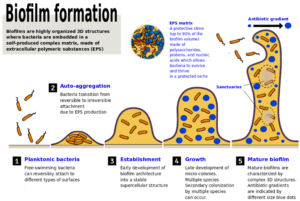
A biofilm begins when individual bacterial cells encounter a suitable surface. Some bacteria are carried by water, air or other organisms until they happen to land on a surface. If conditions are favourable, they attach themselves. At first the attachment may be temporary, but the bacteria can eventually establish a more permanent foothold. They then begin producing a sticky mixture of molecules known collectively as the extracellular polymeric substance, or EPS. Think of EPS as a combination of glue, scaffolding and protective packaging. It can contain polysaccharides, proteins, DNA and other substances. Together these materials form a three-dimensional matrix around the cells. The bacteria are no longer simply a collection of individual cells. They have become a community.
The slime isn’t just slime
The familiar slimy coating found on a wet surface is often a biofilm. But the material surrounding bacteria is far more sophisticated than ordinary slime. The biofilm matrix helps bacteria attach to surfaces and to one another. It also retains water and nutrients and can provide protection from environmental stresses. The matrix can contain channels through which water and dissolved substances move. In other words, a mature biofilm isn’t necessarily a solid lump of bacteria. It is more like a tiny living landscape, with different regions experiencing different conditions. Some areas may have plenty of oxygen, while deeper regions may have very little. Nutrient concentrations can also vary dramatically from one location to another. This means that bacteria living only micrometres apart can experience very different environments.
Bacteria communicate
One of the most fascinating features of biofilms is that bacteria can communicate chemically. Many bacterial species use a process called quorum sensing. Individual bacteria release chemical signalling molecules into their surroundings. As the bacterial population increases, the concentration of these molecules rises. Once a threshold is reached, bacteria can detect that enough neighbours are present and change their behaviour. This allows populations of bacteria to coordinate activities such as biofilm formation, movement and the production of particular molecules. It is rather like a microscopic community receiving a message saying:
“There are enough of us now. Let’s build.”
Quorum sensing isn’t universal and different bacteria use different signalling systems, but it illustrates an important principle: bacteria are not always acting as isolated individuals.
Why biofilms are so difficult to destroy
Biofilms create a serious problem in medicine and industry because bacteria living in a biofilm can be much harder to eliminate than free-living cells. The matrix can slow the penetration of some antimicrobial substances, while the biofilm’s physical structure creates protected microenvironments. Another important factor is that some bacteria inside biofilms grow very slowly. Many antibiotics are most effective against actively growing bacterial cells. Slow-growing cells can therefore be less susceptible.
Biofilms can also contain persister cells — bacterial cells that enter a temporary physiological state in which they are highly tolerant of antibiotics. They are not necessarily genetically resistant; instead, they can survive treatment and potentially repopulate the biofilm afterwards. This helps explain why some infections can be extremely persistent.
Your teeth are covered in biofilm
One of the most familiar examples of a biofilm is dental plaque. After you clean your teeth, bacteria begin attaching to surfaces in your mouth. They interact with one another and with molecules in saliva, gradually developing into a complex microbial community.
If the biofilm isn’t regularly disrupted by brushing and cleaning between the teeth, it can contribute to tooth decay and gum disease. So that slightly fuzzy feeling on your teeth in the morning? You’re feeling a microbial community.
Biofilms can live inside pipes
Biofilms aren’t just a medical problem. They are also important in water systems, industrial pipelines and food-processing equipment. A thin layer of bacteria can establish itself on the inside of a pipe. Once established, the biofilm can accumulate nutrients and other microorganisms. Parts of the biofilm can eventually detach and travel downstream, releasing bacteria into the surrounding system.
Biofilms can also contribute to biofouling, where unwanted biological material accumulates on surfaces.
Plants have biofilms too
Plants live surrounded by microorganisms, and biofilms are an important part of these microbial communities. Bacteria can form biofilms on plant roots and other plant surfaces. The region immediately surrounding a root — the rhizosphere — is particularly rich in microbial activity because roots release sugars, amino acids and other compounds into the soil. Some bacteria living around roots can benefit plants by helping with nutrient acquisition, producing plant-growth-promoting compounds or suppressing certain pathogens. In this context, a biofilm isn’t necessarily something harmful. It can be part of a healthy microbial ecosystem.
Biofilms are everywhere in nature
Look at a stream and you may see rocks covered with a slippery coating. That coating can contain a complex microbial community known as a periphyton or microbial biofilm. Biofilms also develop on sediments, plant surfaces and submerged objects. They are important ecosystems in their own right.
Algae, bacteria, fungi, protozoa and other organisms can interact within these communities. In aquatic environments, biofilms can capture nutrients and organic matter and provide food for grazing organisms.
They are therefore an important part of nutrient cycling.
Biofilms can be good for us
It is easy to think of biofilms as something we should always destroy. But that would be a mistake. Humans themselves are ecosystems containing enormous numbers of microorganisms, and many microbial communities live on and inside us without causing disease. In environmental biotechnology, biofilms can also be extremely useful.
Wastewater-treatment plants rely heavily on microbial communities to remove organic material and nutrients from wastewater. Engineers can deliberately encourage microorganisms to form biofilms on surfaces, turning their natural behaviour into a useful technology. In some systems, microbes living together on a surface can perform chemical transformations that would be difficult to achieve with individual cells.
Biofilms and the future of medicine
Understanding biofilms has become increasingly important because many chronic infections involve microbial communities attached to surfaces. Researchers are investigating ways of preventing bacteria from attaching, disrupting the biofilm matrix, interfering with bacterial communication and improving antimicrobial penetration. Rather than simply trying to kill every bacterium, scientists are increasingly interested in understanding how the microbial community behaves.
This represents an important shift in thinking. The question is no longer simply:
“How do we kill this bacterium?”
It is also:
“How does this microbial community organise itself, survive and interact with its environment?”
The microbial city beneath our feet
Perhaps the most remarkable thing about biofilms is how ordinary they are. They don’t require exotic environments or unusual organisms. They can develop on a tooth, a rock, a plant root, a water pipe or a medical device. And yet, within that microscopic layer, bacteria can communicate, cooperate, compete, exchange nutrients, alter their metabolism and respond collectively to their surroundings.
Biofilms remind us that bacteria are not simply tiny independent organisms. Under the right conditions, they become community builders. And some of the most important microbial communities on Earth are living in a world only a few micrometres thick.