The Tiny Architects of Our Planet: How Microbes Built a Habitable Earth
When we think about the forces that shaped our planet, we usually imagine volcanoes, earthquakes, oceans, and the movement of continents. Few of us would think of microbes – organisms so small that millions can fit on the head of a pin. Yet these invisible life forms have played a crucial role in making Earth the vibrant, living world we know today.
Long before dinosaurs walked the Earth or forests covered the continents, microbes were already hard at work. In fact, for much of our planet’s history, they were the only inhabitants. Over billions of years, they transformed the atmosphere, created fertile soils, regulated the climate, and established the biological cycles that sustain all life.
Breathing Thanks to Microbes
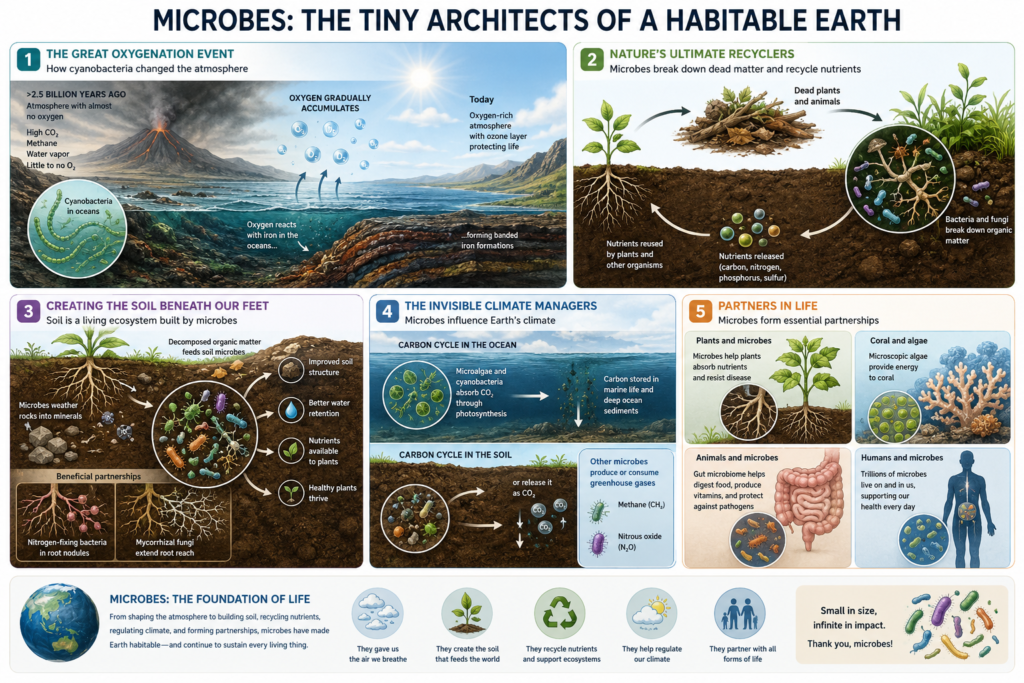
More than 2.5 billion years ago, the Earth’s atmosphere contained almost no oxygen. The air would have been unbreathable for humans and most modern animals. Everything changed when ancient microbes called cyanobacteria evolved the ability to perform photosynthesis, using sunlight to convert carbon dioxide and water into energy.
As a by-product of this process, they released oxygen into the oceans and atmosphere. Over millions of years, oxygen levels gradually increased, triggering what scientists call the Great Oxidation Event. This dramatic transformation paved the way for the evolution of complex life.
The rise of oxygen also led to the formation of the ozone layer, which protects the Earth’s surface from harmful ultraviolet radiation. Without these tiny microbial pioneers, life as we know it would never have evolved.
Nature’s Ultimate Recyclers
Imagine a world in which dead plants and animals never decomposed. Forests would be buried beneath layers of organic matter, and essential nutrients would eventually run out. Fortunately, microbes prevent this from happening.
Bacteria and fungi are nature’s recyclers. They break down leaves, wood, animal remains, and other organic materials, releasing nutrients such as carbon, nitrogen, phosphorus, and sulfur back into the environment. These nutrients can then be reused by plants and other organisms. Thanks to microbial recycling, Earth’s ecosystems remain productive and resilient. Every tree, flower, and blade of grass depends on this invisible workforce.
Creating the Soil Beneath Our Feet
Healthy soil is much more than dirt—it is a living ecosystem. A single teaspoon of soil contains billions of microorganisms, representing thousands of different species. Microbes help create soil by slowly breaking down rocks and mixing mineral particles with decaying organic matter. They also improve soil structure, enhance water retention, and make nutrients available to plants. Many plants rely on beneficial partnerships with microbes. Nitrogen-fixing bacteria convert atmospheric nitrogen into forms that plants can use, while mycorrhizal fungi extend the reach of plant roots, helping them absorb water and nutrients. Without microbes, agriculture would be impossible and natural landscapes would struggle to survive.
The Invisible Climate Managers
Microbes play a surprisingly important role in regulating the Earth’s climate. Microscopic algae and cyanobacteria in the oceans absorb enormous quantities of carbon dioxide through photosynthesis, helping to moderate global temperatures.
At the same time, soil microbes control whether carbon is stored in the ground or released back into the atmosphere. Other microorganisms produce or consume greenhouse gases such as methane and nitrous oxide.
Scientists are increasingly recognizing that understanding microbial communities is essential for tackling climate change and protecting ecosystems.
Partners in Life
Microbes do not merely exist around us—they live with us and within us. Every human being carries trillions of microbes on their skin and in their digestive system. Together, these organisms form the human microbiome.
These microbial communities help digest food, produce vitamins, train the immune system, and protect us against harmful pathogens. Similar partnerships occur throughout nature, from coral reefs to forests and grasslands.
Life on Earth is not a collection of isolated species but an intricate web of relationships in which microbes play central roles.
The Unseen Engineers of Earth
Despite their tiny size, microbes are among the most powerful forces on our planet. They transformed the atmosphere, built fertile soils, recycle nutrients, regulate the climate, and support every ecosystem on Earth. The next time you take a breath, walk through a forest, or enjoy a meal, remember that countless microscopic organisms have helped make those experiences possible.
The story of life on Earth is, in many ways, the story of microbes—the unseen engineers that built a habitable world.